Is Xero Suitable for UAE Businesses? An Honest 2026 Guide
- Xero is currently listed on the UAE Federal Tax Authority's Tax Accounting Software Vendor register; the FTA lists Xero version 2026 as valid until March 2027.
- Xero is a strong fit for many UAE service businesses, startups, professional firms and international SMEs that need cloud accounting, invoicing, reconciliation, reporting and collaboration.
- Xero's dedicated UAE VAT solution is still described by Xero as coming soon, so correct transaction-level VAT coding and review remain important.
- Xero says it is working toward the UAE Accredited Service Provider requirements for eInvoicing; businesses should not assume Xero alone currently satisfies their ASP obligation.
- Xero's UAE site identifies local bank-feed connections including Wio Bank and Alaan, but feed availability should be tested for the specific bank account; manual statement imports remain an alternative.
- Xero's UAE payroll approach relies on specialist third-party payroll apps rather than a native UAE payroll and WPS product.
The Short Answer
Is Xero suitable for UAE businesses? The short answer
Yes: for many UAE businesses, Xero is a very good accounting foundation. It is particularly well suited to service businesses, startups, agencies, consultancies, professional firms and internationally focused SMEs that want cloud bookkeeping, invoicing, bank reconciliation, reporting and easy collaboration with an accountant.
The important qualification is that Xero should not be confused with a complete UAE tax, payroll and eInvoicing system. As of 19 August 2026, Xero is listed by the UAE Federal Tax Authority (FTA) as accredited tax accounting software, but Xero still describes its dedicated UAE VAT and eInvoicing functionality as coming soon. Its UAE payroll proposition also relies on connected specialist apps rather than a native UAE payroll product.
So the practical answer is simple: Xero can hold the books very well. Whether it is enough on its own depends on the complexity of your VAT, payroll, banking, inventory and eInvoicing requirements.
Already using Xero, or considering it for your UAE business? Maaliya adds the UAE-focused layer around your ledger, automating VAT treatment, document checks and bookkeeping workflows.
Book a free consultation today!What Xero Does Well
Xero's core strength is general cloud accounting. A UAE business can use it to record sales and purchases, issue invoices, enter supplier bills, reconcile bank transactions, monitor receivables and payables, track cash flow and produce financial statements.
That makes it especially useful when the finance process is relatively clean and the business wants one shared ledger that the owner, internal finance team and external accountant can access.
- Cloud bookkeeping and real-time access for distributed teams.
- Sales invoicing and supplier bill management.
- Bank reconciliation and bank rules.
- Profit and loss, balance sheet and management reporting.
- Contact, receivables and payables management.
- App integrations for functions that sit outside the core ledger.
- Multi-currency capability on the relevant plan for businesses trading internationally.
For a UAE business moving away from spreadsheets, the biggest upgrade is often not a single feature. It is the discipline of having transactions, supporting records and reconciliations organised in one accounting system.
If you want a broader overview of Xero's UAE features and limitations, see Xero in the UAE: Everything You Need to Know.
Is Xero approved or accredited by the UAE Federal Tax Authority?
Xero is currently listed by the UAE Federal Tax Authority on its Tax Accounting Software Vendor register. The FTA register lists Xero, version 2026, with validity until March 2027.
That is a meaningful positive signal, but it is easy to overread what accreditation means. An FTA-listed accounting platform does not automatically determine the correct VAT treatment for every transaction, guarantee every invoice is compliant, prepare every UAE tax adjustment, or transfer compliance responsibility away from the taxable person.
Accounting software records the treatment selected by the business. The business still needs the underlying VAT logic, documentation and controls to be correct.
How well does Xero handle UAE VAT?
Xero can record VAT at transaction level, but UAE VAT requires more than multiplying an amount by 5%. A business may encounter standard-rated, zero-rated, exempt, out-of-scope and reverse-charge transactions, and the correct treatment affects both the accounting records and the VAT return.
The UAE's standard VAT rate is 5%. For UAE-resident businesses, mandatory VAT registration generally applies when taxable supplies and imports exceed AED 375,000 under the applicable look-back or forward-looking tests, while voluntary registration may be available from AED 187,500 subject to the relevant conditions. Source: UAE Federal Tax Authority, Registration for VAT.
What Xero can do today
A properly configured Xero organisation can be used to record taxable sales and purchases, apply tax rates, reconcile the VAT control balance and maintain the underlying accounting records needed for VAT preparation.
What is still being localised
Xero's UAE website currently states that its dedicated UAE VAT solution is coming soon. Xero describes planned functionality for UAE VAT reporting and guided workflows, which means businesses should not assume that a fully localised UAE VAT-return workflow is already available in every Xero organisation today. Source: Xero UAE, eInvoicing and VAT Software for the UAE.
For VAT-registered businesses, setup quality matters. A generic 5% code used everywhere can produce mathematically correct VAT while still putting a transaction in the wrong category. Zero-rated, exempt and out-of-scope transactions can all produce AED 0 output VAT, but they are not the same legal treatment.
For a detailed setup process, see Setting Up Xero for UAE VAT: Step-by-Step Guide.
Example: why the VAT code matters
Assume a UAE company records an AED 10,000 transaction. A standard-rated domestic sale would normally produce AED 500 of output VAT. A qualifying zero-rated sale could produce AED 0 of output VAT while remaining a taxable supply. An exempt transaction may also produce AED 0, but its VAT consequences differ, including potentially for input-tax recovery. Recording all three as one generic "0%" category destroys information the finance team may need later.
This is why UAE businesses should design VAT codes around the legal treatment and reporting outcome, not only around the percentage.
UAE Bank Connections
Does Xero connect to UAE banks?
Xero supports bank feeds where a compatible connection exists, and its UAE website specifically identifies Wio Bank and Alaan as local connections. For other institutions, availability can depend on the bank, account type and feed provider.
Xero recommends checking the actual connection from within the product. That is important because a bank name appearing in a broader ecosystem does not necessarily mean every corporate account or currency is supported. Source: Xero UAE, Connect Your Bank to Xero.
If a usable feed is unavailable, Xero also supports manual bank-statement imports in common data formats. That keeps Xero usable, but it creates an extra operational step.
What this means in practice
Before choosing Xero, test your real business bank account during the trial. Do not make a software decision based on an assumption that UAE bank feeds are supported in general. The exact account is what matters.
If your bank only provides PDFs or awkward exports, Maaliya's Bank Statement Parser converts statements into clean, structured transaction data ready for your ledger.
Parse your bank statements now!UAE Payroll and WPS Support
Does Xero include UAE payroll and WPS?
Xero does not position its UAE product as a native UAE payroll system. Its UAE payroll page tells businesses to connect specialist third-party payroll applications, with payroll information then flowing into Xero for accounting and reporting.
Source: Xero UAE, Payroll Software for Small Businesses.
That distinction matters because UAE payroll can involve salary calculations, employee records, leave, end-of-service benefits and Wages Protection System processes. A business can still use Xero as the accounting ledger for payroll journals and payments, but a separate payroll or HR platform may be required for the operational and compliance workflow.
If your goal is one application that natively handles accounting, UAE HR, payroll and WPS end to end, Xero alone may not be the cleanest fit.
Is Xero Ready for UAE eInvoicing?
Not as a complete standalone UAE eInvoicing solution yet. Xero says it is working toward the UAE Accredited Service Provider (ASP) requirements and that its UAE eInvoicing functionality is coming soon.
That matters because UAE eInvoicing is not simply emailing a PDF invoice. The Ministry of Finance defines an eInvoice as structured invoice data issued and exchanged electronically and reported electronically to the FTA; PDFs, images and emails are not themselves eInvoices. Source: UAE Ministry of Finance, eInvoicing portal.
Current mandatory timelines
For persons subject to the UAE eInvoicing system with annual revenues exceeding AED 50 million, the Ministry of Finance extended the deadline to appoint an Accredited Service Provider from 31 July 2026 to 30 October 2026. The mandatory implementation date remains 1 January 2027. Source: UAE Ministry of Finance, targeted amendments announced 10 May 2026.
For businesses below AED 50 million, Xero's UAE guidance reflects an ASP appointment deadline of 31 March 2027 and mandatory implementation from 1 July 2027.
The MoF also maintains a periodically updated list of pre-approved service providers. Xero's own UAE page states that it is still working toward the ASP requirements, so a business with a mandatory deadline should verify the current MoF provider position rather than assuming its accounting software automatically satisfies the ASP requirement. Source: UAE Ministry of Finance, Pre-Approved eInvoicing Service Providers.
Which types of UAE businesses are a strong fit for Xero?
1. Professional-service businesses
Consultancies, agencies, legal and advisory firms, technology companies and other service businesses often have relatively straightforward inventory needs. Xero's invoicing, bills, expense tracking, reconciliation and reporting can cover the accounting core well.
2. Startups and founder-led SMEs
Startups usually benefit from cloud access, easy collaboration with an outsourced accountant and the ability to connect specialist apps as the company grows. Xero can provide a structured ledger without the implementation burden of a full ERP.
3. International and multi-currency businesses
Businesses that invoice overseas customers, pay foreign suppliers or maintain non-AED balances may benefit from Xero's multi-currency features on the relevant subscription plan.
4. Businesses working closely with external accountants
A shared cloud ledger is particularly valuable when an external bookkeeper, accountant, tax adviser or auditor needs access. It reduces version-control problems caused by emailing spreadsheets or backup files.
5. Businesses that prefer a modular software stack
Some companies do not want one huge ERP. They prefer a strong accounting ledger connected to separate tools for payroll, expenses, ecommerce, document processing, forecasting or VAT workflows. Xero fits that model well.
When Xero May Not Be the Best Standalone Choice
When might Xero not be the best standalone choice in the UAE?
Xero can still be usable in the following situations, but the business may need additional applications, stronger configuration or a more specialised ERP.
- Complex manufacturing, bills of materials or production planning.
- Advanced multi-warehouse inventory and logistics.
- A requirement for native UAE payroll and WPS in the same platform.
- A requirement for a currently complete UAE eInvoicing ASP solution without another provider.
- Highly specialised industry workflows that depend on a sector-specific ERP.
- Complex UAE VAT scenarios where the business wants deep local tax automation rather than manual tax-code governance.
- Businesses that need extensive local onsite implementation or support as part of the software package.
The key question is not whether Xero is “good” or “bad.” It is whether Xero's ledger-plus-integrations model matches the way your finance operation actually works.
Xero Pricing in the UAE
How much does Xero cost in the UAE?
As of 19 August 2026, Xero's UAE website shows regular monthly prices of USD 7 for Lite, USD 29 for Starter, USD 50 for Standard and USD 75 for Premium, before any temporary promotional discount. Xero states that pricing can change, so the live pricing page should be checked before purchase. Source: Xero UAE, Pricing Plans.
Xero UAE Monthly Pricing (as of August 2026)
Regular monthly prices before any temporary promotional discount. Xero states that pricing can change, so check the live pricing page before purchasing.
| Plan | Monthly Price (USD) |
|---|---|
| Lite | $7 |
| Starter | $29 |
| Standard | $50 |
| Premium | $75 |
Choosing the Right Plan
Do not choose a plan only by price. The practical cost is the subscription plus any connected payroll, expense, bank-feed, document-processing, reporting or compliance tools that your workflow requires.
For many operating SMEs, paying more for the right feature set is usually cheaper than building monthly workarounds around an undersized plan.
Xero Plus a UAE Finance Layer
Xero versus a UAE-focused finance workflow
A useful way to think about Xero is as the accounting ledger. It is where approved transactions, balances and financial reports ultimately live.
A UAE-focused finance layer can sit around that ledger to handle work that is more local or operational: invoice capture, document checks, transaction coding, VAT treatment, bank-statement processing, approval flows and VAT preparation.
That is the logic behind using Maaliya alongside Xero. Rather than forcing a business to abandon Xero, Maaliya can focus on the work around the accounting system.
For a broader comparison of AI bookkeeping approaches, see Best AI Bookkeeping Software for UAE Businesses (2026) and Maaliya vs Dext for UAE Businesses: Which AI Bookkeeping Solution Is Better?.
Run a quick check on how your transactions are being treated for UAE VAT and catch coding issues before they reach a return.
Check VAT Health NowDecision Checklist
Decision checklist: should your UAE business choose Xero?
Xero is likely to be a good fit if most of the following statements are true:
- You want cloud accounting rather than desktop software or spreadsheets.
- Your core needs are bookkeeping, invoicing, bills, reconciliation and financial reporting.
- Your business is service-led or has relatively straightforward inventory requirements.
- You want your accountant or finance team to collaborate in one ledger.
- You are comfortable using integrations for payroll or specialised workflows.
- You have tested the bank-feed options for your actual UAE bank accounts.
- You are prepared to configure UAE VAT treatments correctly rather than rely on generic defaults.
- You understand that eInvoicing ASP readiness is a separate requirement that must be verified against current MoF guidance.
Consider a more specialised platform or a larger ERP if you need deep manufacturing, advanced warehouse operations, a single native UAE HR, payroll and WPS stack, or highly specialised industry workflows.
Final Verdict
Final verdict
Xero is suitable for a large segment of UAE SMEs, and its FTA accreditation strengthens its position as a credible accounting platform in the country. For many service businesses and internationally oriented companies, it can be an excellent ledger.
Its limitations are also real. UAE VAT localisation is still being expanded, UAE eInvoicing capability is still being rolled out, and native UAE payroll is not the core proposition. Those gaps do not make Xero unsuitable; they simply mean the business should design the surrounding finance stack deliberately.
For most UAE SMEs evaluating Xero, the best decision is not “Xero or everything else.” It is: what should Xero handle, what needs a local specialist layer, and how will the systems stay connected?
This article is general information, not personalised tax, accounting or legal advice. UAE tax and eInvoicing requirements can depend on the facts of the business and may change; confirm material compliance decisions against current FTA and Ministry of Finance guidance.
Related Reading

Xero in the UAE: Everything You Need to Know
Xero is now FTA-listed in the UAE, but important gaps remain around native VAT returns, payroll and eInvoicing. This guide explains what Xero can do, what it cannot yet do and how Maaliya adds UAE VAT automation through its live Xero integration.
Setting Up Xero for UAE VAT: Step-by-Step Guide
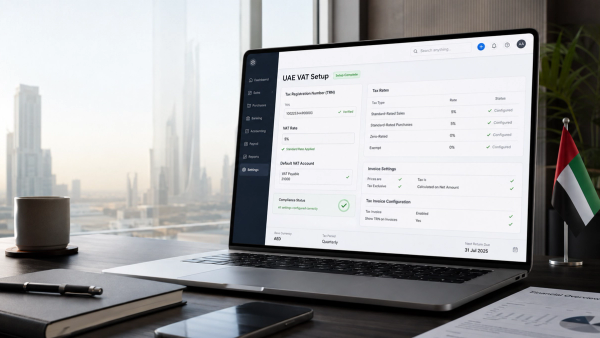
Setting up Xero for UAE VAT takes more than adding a 5% tax rate. This guide walks through TRN setup, VAT codes, invoice configuration, VAT accounts, opening balances and testing your setup.

Best AI Bookkeeping Software for UAE Businesses (2026)
Looking for the best AI bookkeeping software in the UAE? Compare the top platforms for invoice processing, receipt scanning, bookkeeping automation, VAT workflows, and accounting efficiency in 2026.

Maaliya vs Dext for UAE Businesses: Which AI Bookkeeping Solution Is Better?
Comparing Maaliya and Dext? Learn how they differ in AI bookkeeping, document processing, VAT workflows, integrations, and why UAE businesses may benefit from a locally focused solution.
Sources
Sources
- UAE Federal Tax Authority, Tax Accounting Software Vendors, page last updated 19 May 2026, accessed 19 August 2026.
- UAE Federal Tax Authority, Registration for VAT, page last updated 6 April 2026, accessed 19 August 2026.
- UAE Ministry of Finance, eInvoicing, current programme portal, accessed 19 August 2026.
- UAE Ministry of Finance, Ministry of Finance announces targeted amendments to eInvoicing system decisions, 10 May 2026, accessed 19 August 2026.
- UAE Ministry of Finance, Pre-Approved eInvoicing Service Providers, periodically updated list, accessed 19 August 2026.
- Xero UAE, eInvoicing and VAT Software for the UAE, accessed 19 August 2026.
- Xero UAE, Pricing Plans, accessed 19 August 2026.
- Xero UAE, Connect Your Bank to Xero, accessed 19 August 2026.
- Xero UAE, Payroll Software for Small Businesses, accessed 19 August 2026.
Frequently Asked Questions
Yes. UAE businesses can use Xero, and it is currently included on the FTA’s accredited tax accounting software register.
Xero can calculate tax at transaction-line level using configured tax rates. Correct VAT reporting still depends on selecting the appropriate treatment and mapping the transaction correctly.
Xero’s native UAE VAT-return mapping and filing workflow is not yet generally available. Xero describes it as coming soon. Businesses can use Maaliya’s live integration to automate UAE VAT treatment and return preparation while maintaining Xero as the ledger.
Bank-feed availability varies by bank and account type. Xero specifically advertises direct UAE feeds from Wio and Alaan and may provide other feeds through an integrated provider. Search for the exact bank and account inside Xero before subscribing.
Where no reliable feed exists, use the Maaliya Bank Statement Parser to convert statements into structured transaction data.
Not natively as a complete UAE payroll system. Xero recommends integrating a specialist payroll application.
Not yet. Xero says it is working towards the ASP requirements and plans to launch UAE eInvoicing functionality. Businesses should monitor both Xero’s product status and the official MoF timetable.
Built for the UAE.