Maaliya AppFinance software you use yourself
AccountingOur accountants run your finances
Business ServicesSet up, run or close a UAE company
ResourcesGuides, research and free tools
About usWho we are and how to reach us
UAE eInvoicing Readiness Checklist for SMEs Under AED 50 Million
 Lina Mansouri
Overview
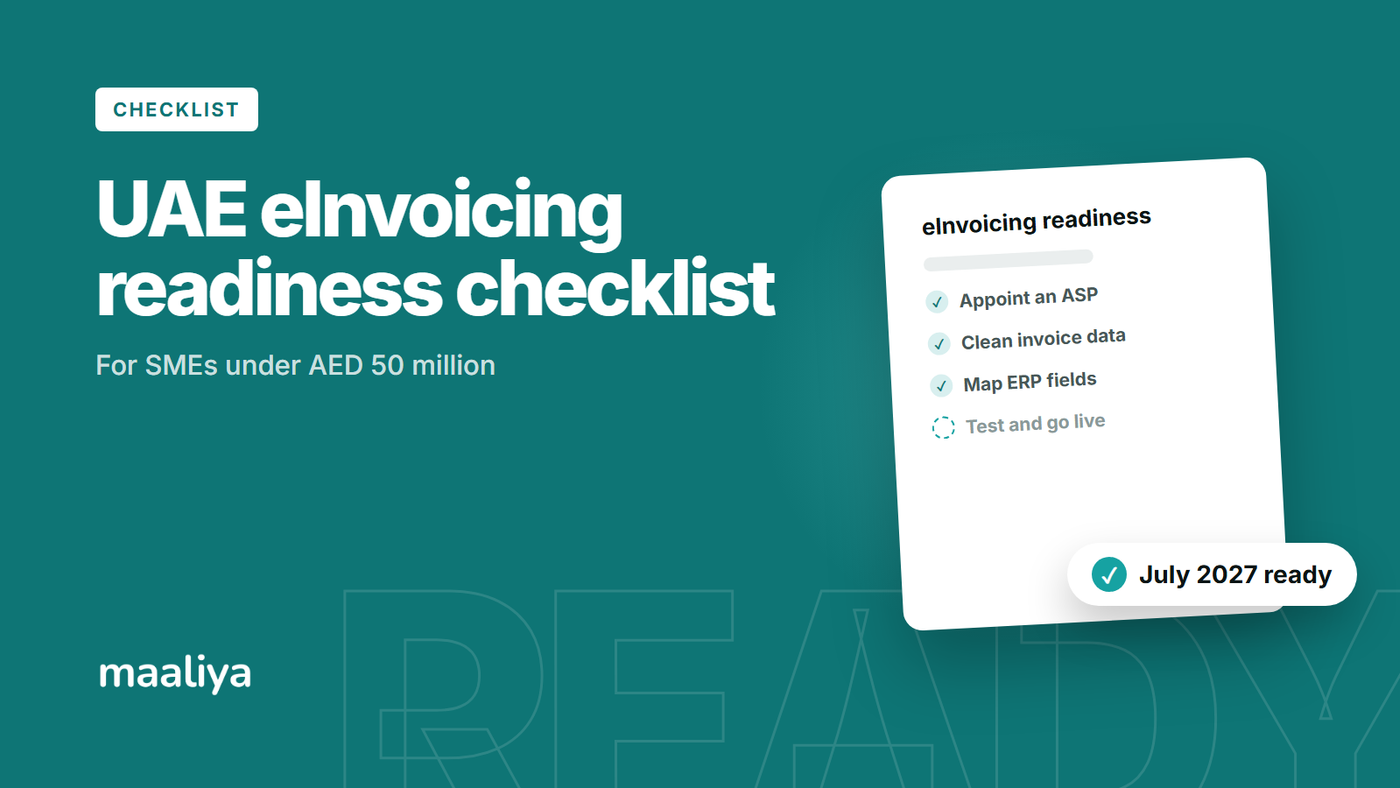
UAE businesses with annual revenue below AED 50 million that make in-scope B2B or B2G supplies must appoint an Accredited Service Provider by 31 March 2027 and implement eInvoicing by 1 July 2027. Getting ready means mapping which invoices are in scope, cleaning up master data, choosing and testing with an ASP, and building the operating controls that keep invoices flowing once the system goes live.
- Key Takeaways
- Who Needs This UAE eInvoicing Readiness Checklist?
- The Two Dates SMEs Cannot Miss
- Step 1: Map In-Scope Invoices and Credit Notes
- Step 2: Audit Invoice and Customer Master Data
- Step 3: Appoint and Evaluate an Accredited Service Provider
- Step 4: Map Your Accounting System to the ASP
- Step 5: Run an End-to-End Acceptance Test
- Step 6: Build Operating Controls Before July 2027
- A Realistic SME Preparation Schedule
- Common Readiness Mistakes
- Frequently Asked Questions
- Sources
- In-scope businesses below AED 50 million in annual revenue must appoint an ASP by 31 March 2027 and implement eInvoicing by 1 July 2027.
- The deadline applies to every relevant in-scope business, not only to VAT-registered ones.
- PDFs and emailed invoices are not substitutes for structured eInvoices exchanged through the required network.
- Clean up customer and supplier data, VAT codes, invoice numbering and credit-note processes before integration.
- Run end-to-end tests with your ASP and set up rejection and outage procedures before go-live.
Who Needs This UAE eInvoicing Readiness Checklist?
This checklist is for UAE businesses with annual revenue below AED 50 million that make in-scope business-to-business or business-to-government supplies. Under Ministerial Decision No. 244 of 2025, their ASP appointment deadline is 31 March 2027, and mandatory implementation begins 1 July 2027. The official implementation decision sets out the phases.
The AED 50 million boundary is an implementation-phase test, not a general exemption for smaller companies. A business with AED 2 million in annual revenue can still be in scope. Businesses engaged exclusively in B2C transactions are excluded until a further ministerial decision, so assess your transaction types and any specific exclusions before choosing a provider.
The Two Dates SMEs Cannot Miss
Two deadlines matter most for businesses below AED 50 million in revenue: appoint an Accredited Service Provider by 31 March 2027, and implement eInvoicing by 1 July 2027. The table below also shows the deadlines that apply to larger businesses and government entities, for context.
The large-business ASP deadline was amended in May 2026, but the SME dates remained unchanged. The Ministry of Finance announcement explains the extension. Do not confuse appointing an ASP with completing integration and testing.
| In-scope entity | Appoint accredited provider | Mandatory go-live |
|---|---|---|
| Revenue below AED 50 million | 31 March 2027 | 1 July 2027 |
| Revenue at least AED 50 million | 30 October 2026 | 1 January 2027 |
| Government entities | 31 March 2027 | 1 October 2027 |
Step 1: Map In-Scope Invoices and Credit Notes
List every source of customer invoices: accounting software, point-of-sale systems, spreadsheets, subscription billing and manual credit notes. Classify each flow as B2B, B2G, B2C or potentially excluded, and record the reason. Identify branch and group-company transactions separately.
The October 2026 amendment introduced a temporary 24-month exclusion from 1 January 2027 for certain transactions between members of the same tax group. Confirm eligibility against the Ministry of Finance amendment announcement rather than assuming every related-party invoice is exempt.
Step 2: Audit Invoice and Customer Master Data
Structured invoice validation is unforgiving of inconsistent master data. Check legal supplier and buyer names, addresses, tax registration identifiers where applicable, currencies, invoice dates, unique numbers, item descriptions, quantities, discounts, VAT categories and credit-note references. Review the UAE-compliant invoicing guide for the underlying invoice controls.
Example: a UAE consulting firm bills a VAT-registered client AED 10,000 plus AED 500 VAT. The structured record needs the correct supplier and buyer details, an AED 10,000 taxable value, a 5% tax category, AED 500 tax and an AED 10,500 total. A visually correct PDF cannot fix a missing structured field.
Step 3: Appoint and Evaluate an Accredited Service Provider
Ask prospective ASPs for proof of current UAE accreditation, integration methods, supported invoice and credit-note flows, exception handling, uptime commitments, data protection arrangements, support hours, onboarding charges and recurring fees. The MoF accreditation service describes provider requirements.
Do not treat an ASP's marketing claim or earlier preliminary approval as proof of current accreditation. Ministerial Decision No. 168 of 2026 introduced a revised accreditation framework effective October 2026.
Step 4: Map Your Accounting System to the ASP
Document where each required field comes from and who owns it, and decide whether invoices will be sent through an API, middleware or a provider portal. Test invoices in AED and foreign currencies, multiple VAT treatments, partial credits, cancellations and corrections. If your business uses Xero, review Xero UAE tax rates and Xero's UAE eInvoicing position.
Step 5: Run an End-to-End Acceptance Test
- Create a valid test invoice, send it through the ASP and verify receipt and status at the destination.
- Test missing buyer identifiers, invalid tax categories and duplicate invoice numbers.
- Test credit notes, invoice corrections and re-submission after rejection.
- Verify the required tax-data reporting and reconcile ASP statuses against the sales ledger.
- Assign an owner for failures, service interruptions and unresolved exceptions.
Step 6: Build Operating Controls Before July 2027
Document who may issue invoices, who fixes rejected records, when finance reconciles the ASP dashboard, and how evidence is retained. Review existing VAT coding issues using common Xero VAT mistakes. Train sales, operations and finance staff together: eInvoicing is not just an IT project.
A Realistic SME Preparation Schedule
The workplan below is planning guidance, not a set of statutory milestones.
| Period | Priority | Deliverable |
|---|---|---|
| November-December 2026 | Scope and data audit | Transaction map and master-data cleanup |
| January-February 2027 | ASP procurement and integration design | Signed provider arrangement and field map |
| By 31 March 2027 | ASP appointment | Appointment completed by statutory deadline |
| April-June 2027 | End-to-end testing and staff training | Tested workflows and exception log |
| 1 July 2027 | Mandatory implementation | Live compliant exchange for in-scope transactions |
Common Readiness Mistakes
- Assuming a business below AED 50 million is exempt rather than in a later phase.
- Assuming PDF delivery is equivalent to a structured eInvoice.
- Signing with an unverified provider without confirming current accreditation.
- Leaving credit notes, rejections and foreign-currency invoices out of testing.
- Waiting until the appointment deadline to start technical integration.
Maaliya collects and validates customer and supplier TRNs with vendor detail requests, issues FTA-compliant invoices by default, and covers eInvoicing through its ASP partners.
Explore Smart FTA InvoicingFrequently Asked Questions
Yes, if they are within scope for B2B or B2G transactions. Businesses below AED 50 million annual revenue have the later phase: ASP appointment by 31 March 2027 and implementation from 1 July 2027.
No. The Ministry of Finance explicitly says PDFs, Word files, images, scanned copies and emails are not eInvoices. A compliant eInvoice is structured data exchanged and reported electronically.
Potentially yes. The FTA states that B2B and B2G transactions are covered regardless of VAT registration status, subject to the implementation scope and exclusions.
Yes. Voluntary implementation has been available since 1 July 2026, subject to meeting the applicable technical requirements.
Ask the accredited provider about supported middleware or portal-based workflows, since many SMEs will submit invoices through a provider portal rather than a direct system integration. Test the full workflow, including rejections and corrections, before the mandatory go-live date.
On Done-for-you plans, Maaliya's accountants prepare your books and invoicing for go-live.
Book a free consultation today!Related Maaliya Content
Sources
Ministerial Decision No. 244 of 2025 on implementation, UAE Ministry of Finance. Accessed 18 November 2026.
Targeted amendments to eInvoicing decisions, UAE Ministry of Finance. 10 May 2026. Accessed 18 November 2026.
Amendments to electronic invoicing regulations, UAE Ministry of Finance. 19 October 2026. Accessed 18 November 2026.
Accreditation of eInvoicing Service Providers, UAE Ministry of Finance. Accessed 18 November 2026.
This checklist is general compliance information, not a substitute for advice tailored to your business and current FTA guidance.
Lina Mansouri is a Corporate Services specialist at Maaliya, where she helps UAE businesses with company incorporation, VAT and corporate tax registration, and liquidation. She writes Maaliya's guides to Xero, UAE VAT, bank reconciliation and eInvoicing, drawing on the questions UAE founders and finance teams bring to Maaliya every day.
Like what you read? Add Maaliya as a preferred source on Google.
Built for the UAE.